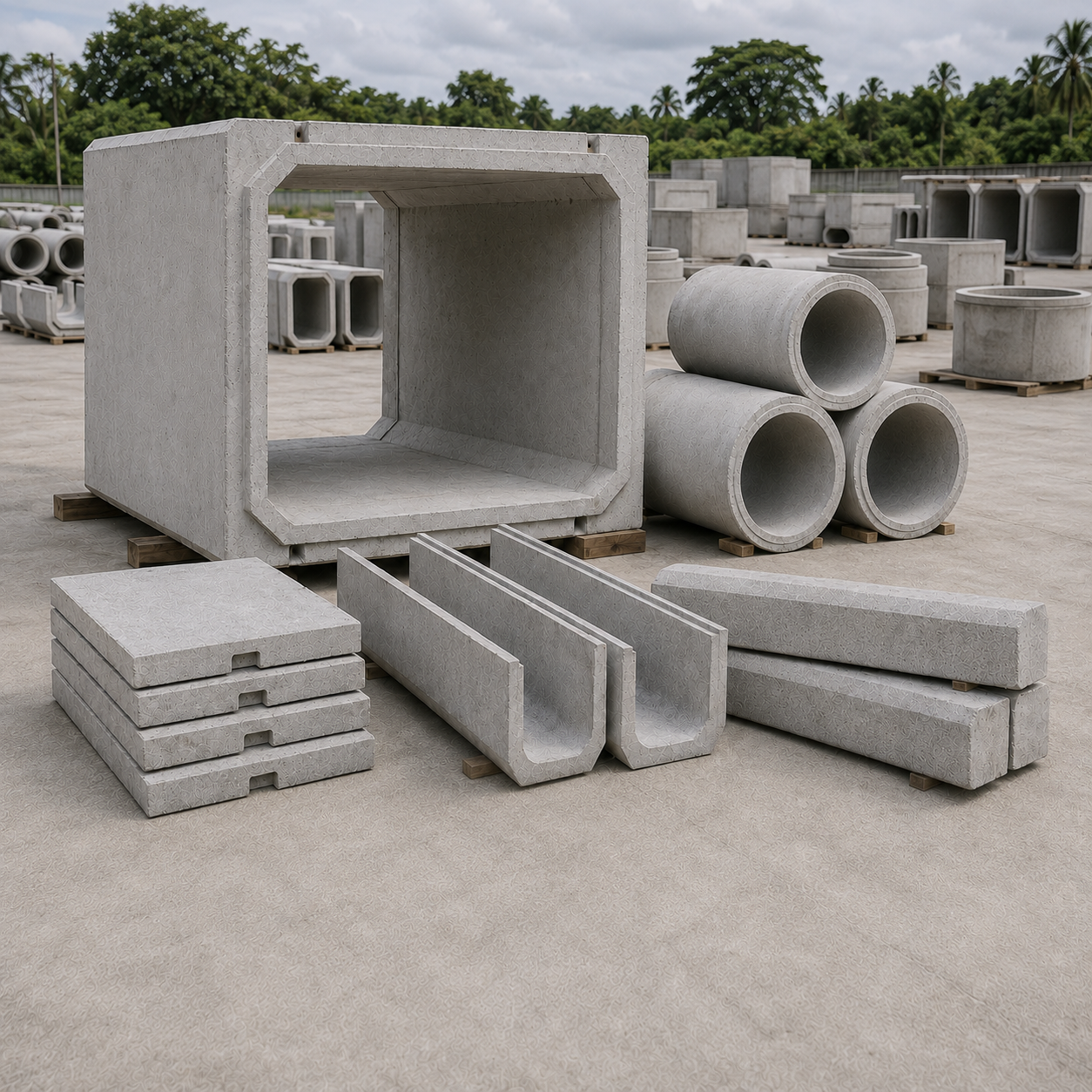
Precast Concrete, Culvert & Drainage
Supplies precast concrete culvert and drainage products for roads, housing developments, factories, commercial sites, agricultural areas and infrastructure projects. The range includes Reinforced Concrete Box Culverts, circular Concrete Culvert Pipes, U-Drains, Drain Cover Slabs, Precast Concrete Slabs and Concrete Kerbs in selected dimensions and load requirements. Contact Cendrex with the project drawing, internal dimensions, quantity and delivery location for current supplier specifications, project pricing and delivery arrangements across different states in West Malaysia.
Description
Precast concrete drainage products are manufactured in controlled factory conditions before being transported to site. They can reduce site formwork, reinforcement fixing and curing work while providing repeatable dimensions along a drainage line. Box culverts, circular pipes and U-drains are used to collect or convey stormwater, cross beneath roads and entrances, protect watercourses and form open or covered drainage systems.
The correct product cannot be selected from the opening size alone. Hydraulic capacity, internal width or diameter, design flow, gradient, earth cover, traffic loading, soil condition, groundwater, joint type, bedding, backfill and outlet arrangement all affect performance. Heavy precast units also require planned lifting points, crane or excavator capacity, truck access and safe storage before installation.
Cendrex’s category combines the main concrete culvert and drainage products customers commonly request. Reinforced Concrete Box Culverts provide a large rectangular or square waterway for crossings and buried drainage. Reinforced Concrete Pipes form circular culverts and underground stormwater lines. U-Drains create open channels and can be paired with load-appropriate concrete covers. Drain Cover Slabs provide removable access while protecting selected channels, and Kerbs control road edges and help guide surface runoff.
Products may be available in standard manufacturer sizes or manufactured for project-specific loading and geometry. Cendrex should quote against the approved civil or structural drawing wherever possible. Dimensions, reinforcement, concrete grade, load class and certification must be confirmed from the actual manufacturer rather than inferred from a generic product photograph.
Product Comparison
| Product | Basic form | Main drainage role | Key selection details | Typical handling concern |
|---|---|---|---|---|
| Reinforced Concrete Box Culvert | Enclosed rectangular or square precast section | Buried road crossings, large stormwater channels and waterways | Internal width and height, unit length, earth cover, traffic load, DWF channel and joint detail | High unit weight, crane capacity, lifting points and balanced bedding |
| Reinforced Concrete Culvert Pipe | Circular reinforced precast pipe | Underground stormwater, culverts and road crossings | Internal diameter, pipe class, joint type, unit length and bedding specification | Rolling prevention, pipe-end protection and controlled lifting |
| Precast Concrete U-Drain | Open U-shaped channel | Roadside, factory, housing and compound drainage | Internal width and depth, wall thickness, unit length, DWF option, cover and side loading | Avoid lifting through unsupported side walls; seat on uniform bedding |
| Concrete Drain Cover Slab | Flat removable reinforced slab | Covers selected U-drains and access channels | Clear span, slab dimensions, reinforcement, pedestrian or traffic duty and lifting detail | Uneven support and incorrect load rating can cause failure |
| Precast Concrete Slab | Flat or shaped factory-made slab | Utility covers, access platforms and related infrastructure | Length, width, thickness, reinforcement, support and design load | Lift only by approved points and support evenly |
| Concrete Kerb | Long precast edging profile | Defines road or pavement edges and helps guide runoff | Profile, unit length, radius pieces, foundation and line or level | Long units need level support to avoid cracking |
Actual dimensions and load capacities vary by manufacturer. The engineer’s drawings and hydraulic design take priority over the typical descriptions in this table.
1. Reinforced Concrete Box Culvert
Product Overview
A Reinforced Concrete Box Culvert is a rigid rectangular or square precast unit used to form a buried waterway or access crossing. Multiple units are installed end to end to create the required culvert length. Compared with circular pipes, a box section can provide a broad opening where vertical space is limited or where the hydraulic design calls for a wide flow area.
Box culverts may be designed with a flat invert or with a Dry Weather Flow channel, commonly abbreviated as DWF. The smaller DWF channel concentrates low everyday flow so water is less likely to spread as a shallow layer across the full culvert width. During heavy rainfall, the complete opening remains available to carry larger stormwater flow.
Selection depends on more than internal width and height. The designer should consider superimposed earth cover, vehicle loading, groundwater, soil pressure, inlet and outlet conditions, scour protection, joint sealing and the effect of differential settlement. The prepared foundation must provide uniform support beneath the unit. Backfill should be placed in controlled layers and kept reasonably balanced on both sides to avoid uneven wall pressure.
Typical Specification Fields
- Internal clear width and height
- External dimensions and wall or roof thickness
- Unit length and total culvert run
- Concrete strength and reinforcement design
- Standard or project-specific load condition
- Minimum and maximum earth cover
- With or without DWF channel
- Joint profile and sealing treatment
- Unit mass, lifting points and crane requirement
- Bedding, backfill and headwall details
Recommended Applications
Road crossings, access-road culverts, large stormwater drains, waterways beneath embankments, industrial developments, housing projects, agricultural crossings and infrastructure works.
Important Buying Note
Send the approved culvert schedule or civil drawing. A box culvert should not be substituted by opening size alone because roof loading, wall pressure, cover depth and foundation conditions can differ substantially between projects.
2. Reinforced Concrete Pipe / Culvert Pipe
Product Overview
Reinforced Concrete Pipes, also called RC pipes or concrete culvert pipes, form rigid circular conduits for stormwater, drainage and crossings. Pipes are manufactured in different internal diameters, wall thicknesses, reinforcement arrangements, load classes and joint configurations. Multiple pipe sections are laid to line and gradient, joined and surrounded with the specified bedding and backfill.
Common joint systems include rebated or ogee joints and spigot-and-socket joints. Some spigot-and-socket pipes use rubber rings to provide a more flexible and controlled seal, while other systems use approved mortar or jointing materials. The correct joint depends on the pipe design, settlement tolerance, leakage requirement and installation specification.
Pipe capacity is governed by internal diameter, gradient, roughness, inlet control and outlet conditions. Structural selection must also consider burial depth, soil support, construction loading and final traffic loading. A large diameter does not automatically mean a higher load class. Pipe markings and current manufacturer documentation should be checked before installation.
Typical Specification Fields
- Nominal internal diameter
- Unit length and total pipeline length
- Reinforced or unreinforced construction
- Pipe class or proof-load requirement
- Rebated, ogee, spigot-and-socket or other joint type
- Rubber ring, mortar or specified jointing system
- Bedding class and trench width
- Minimum and maximum cover
- Pipe mass and lifting arrangement
- Required product certification
One established Malaysian manufacturer publishes reinforced concrete pipe ranges from approximately 300 to 1,800 mm nominal diameter, but this should be treated as a manufacturer reference rather than a promise of Cendrex’s current stock.
Recommended Applications
Stormwater pipelines, road culverts, entrance crossings, industrial drainage, housing infrastructure, agricultural drains and other underground water-conveyance systems.
Important Buying Note
Provide the full pipe schedule including internal diameter, class, joint type, length and quantity. Protect pipe ends during loading and prevent circular units from rolling in storage or transit.
3. Precast Concrete U-Drain
Product Overview
Precast Concrete U-Drains are open-channel units with a base and two side walls. They are installed in sequence to form roadside drains, perimeter drains and surface-water channels. Factory casting produces a consistent cross-section and reduces site formwork compared with casting the entire drain in place.
U-drains may be supplied with or without a DWF channel. A DWF channel is useful where everyday low flow should remain concentrated, while the larger open section provides storm capacity during heavy rainfall. Cover slabs can be added where pedestrian access, vehicle crossing or protection from debris is required, but the drain and cover must both be designed for the intended loading.
The installation base should be level, stable and prepared to provide uniform support along the full drain length. Joint gaps and sealing should follow the project specification. Side backfill should be selected and compacted carefully; heavy vibratory equipment immediately beside unsupported side walls may damage the unit.
Typical Specification Fields
- Internal channel width and depth
- External width and overall height
- Unit length; 1 m is a common manufacturer format
- Wall and base thickness
- Reinforcement and concrete grade
- With or without DWF channel
- Open or covered installation
- Pedestrian, light-vehicle or heavy-vehicle loading
- Joint treatment and outlet details
- Unit mass and lifting method
Recommended Applications
Roadside drainage, factory perimeters, housing projects, car parks, commercial compounds, agricultural sites, landscaped channels and infrastructure work.
Important Buying Note
Order by internal width × internal depth × unit length, together with the load condition and cover requirement. A general request for “one-foot U-drain” may be insufficient because suppliers can use different internal or external dimension references.
4. Concrete Drain Cover Slab
Product Overview
Concrete Drain Cover Slabs are precast reinforced panels placed over compatible U-drains, channels or utility openings. They can provide pedestrian access, vehicle crossing or general protection while allowing selected sections to be removed for cleaning. The slab must be supported on the designed bearing edges and sized for the clear span.
Cover thickness alone does not establish load capacity. Reinforcement, concrete strength, clear span, support condition and concentrated wheel loads all affect performance. A slab intended for a pedestrian drain should not be placed across a driveway unless its traffic-duty rating is confirmed.
Typical Specification Fields
- Overall length, width and thickness
- Clear opening or drain size
- Reinforcement arrangement
- Pedestrian, light-duty or heavy-duty design load
- Solid, slotted or access-opening design
- Bearing length and seating detail
- Individual unit mass and lifting recesses
Recommended Applications
Covered U-drains, pedestrian walkways, service channels, factory compounds, roadside drains and selected vehicle crossings where properly rated.
Important Buying Note
Confirm the actual drain opening, clear span and required load. Do not select a cover only by matching its external width to the top of the drain.
5. Precast Concrete Slab
Product Overview
Precast Concrete Slabs are factory-made flat components used for project-specific covers, platforms, walkways and utility applications. They reduce the need for site formwork and can be installed after achieving the manufacturer’s specified maturity. Depending on the design, a slab may be reinforced, prestressed or produced with lifting recesses.
The support arrangement is essential. A slab designed for bearing along two edges may not be suitable for point support or a different span. Lifting forces can also differ from in-service loads, so the approved lifting points and orientation should be used.
Typical Specification Fields
- Length, width and thickness
- Concrete strength and reinforcement
- Designed clear span and support edges
- Service load and concentrated load requirement
- Surface finish and edge profile
- Lifting points, unit mass and installation method
Recommended Applications
Utility covers, access platforms, drain-related infrastructure, equipment bases, walkways and other approved precast construction.
Important Buying Note
Provide a drawing or complete dimensions and loading. Generic precast slabs should not be used as load-bearing covers without verified design information.
6. Precast Concrete Kerb
Product Overview
Precast Concrete Kerbs form durable boundaries along roads, car parks, drains, traffic islands and landscaped areas. Kerbs can restrain paving, guide vehicle movement, control surface levels and help direct runoff toward drainage inlets. Profiles may include road kerbs, mountable kerbs, splayed kerbs, channel units and project-specific shapes.
Kerbs should be installed to the required line and level on a prepared concrete foundation or bed. Haunching and joint treatment maintain alignment and help resist traffic or paving pressure. Curves may require purpose-made radius units or correctly detailed short sections.
Typical Specification Fields
- Profile and cross-sectional dimensions
- Unit length
- Straight, radius, dropper or transition piece
- Concrete strength and finish
- Foundation, bedding and haunching detail
- Quantity in pieces or total linear metres
Recommended Applications
Road edges, parking bays, traffic islands, footpaths, driveways, drain edges and landscaping.
Important Buying Note
Provide the kerb profile or drawing, not only the overall height. Similar-looking kerbs may have different face slopes, widths and installation functions.
Quick Selection Guide
| Project requirement | Recommended starting point |
|---|---|
| Large buried rectangular waterway or crossing | Reinforced Concrete Box Culvert |
| Circular underground stormwater line or entrance crossing | Reinforced Concrete Pipe / Culvert Pipe |
| Open roadside or perimeter channel | Precast Concrete U-Drain |
| Covered U-drain with removable access | U-Drain plus load-rated Concrete Drain Cover Slabs |
| Project-specific platform or utility cover | Engineered Precast Concrete Slab |
| Road, car-park or pavement edge | Precast Concrete Kerb |
Information Required for a Quotation
For faster and more accurate pricing, provide:
- Product type: box culvert, RC pipe, U-drain, cover slab or kerb
- Approved drawing, bill of quantities or product schedule
- Internal dimensions and unit length
- Pipe diameter, class and joint type
- U-drain width, depth and DWF requirement
- Box-culvert width, height, cover depth and traffic loading
- Cover-slab clear span and pedestrian or vehicle duty
- Quantity in pieces, metres or total run length
- Required standard, certificate or manufacturer approval
- Delivery address in West Malaysia
- Site route, gate width, turning space and ground condition
- Crane, excavator, forklift or self-unloading requirement
- Preferred delivery sequence and installation programme
Delivery, Handling and Installation Planning
Precast concrete products are heavy and can be damaged by incorrect lifting even when they appear robust. The delivery plan should confirm truck payload, road restrictions, access width, turning radius, overhead clearance, ground bearing condition and unloading equipment. Units should arrive in an installation-friendly sequence so unnecessary rehandling is reduced.
Use the manufacturer’s lifting points, pins, slings or spreader-beam arrangement. Circular pipes must be chocked against rolling. U-drains and slabs should rest on stable level supports. Box culverts require appropriate crane capacity and lifting geometry. Damaged edges, exposed reinforcement or cracked units should be inspected before installation.
Cendrex can coordinate deliveries across different states in West Malaysia, subject to product source, order quantity, vehicle availability, access conditions and scheduling. Heavy loads may require staged deliveries or site-arranged crane unloading.
Related Products to Consider Adding When Stocked
This category may be expanded with individual pages for:
- Precast concrete manhole rings, covers and bases
- Porous concrete subsoil drainage pipes
- Headwalls, wing walls and end sections
- L-shaped retaining-wall units
- Concrete sump and catch-pit components
- Precast road barriers
- Concrete septic tanks
- Large-diameter or jacking pipes
Do not publish these as stocked products until the current manufacturer, dimensions, load classification, certification and delivery capability are confirmed.
Category Call to Action
Send Cendrex your drainage drawing, culvert schedule or bill of quantities for a current quotation. Include the internal dimensions, pipe class or load requirement, unit length, quantity, delivery location and unloading plan. Cendrex can check supplier availability, technical documents, project pricing and delivery arrangements across different states in West Malaysia.
Suggested buttons: Request a Culvert Quote · Check Current Sizes · WhatsApp Cendrex
Internal-Link Suggestions
- Link culvert bedding and backfill references to Sand & Aggregates.
- Link reinforced units to Steel Reinforcement.
- Link headwalls and surrounding construction to Cement & Cement-Based Products.
- Link road edges and surrounding works to Concrete Kerbs.
- Link each available product name to its individual product page.
- Add a breadcrumb:
Home > Building Materials > Precast Concrete, Culvert & Drainage.
Structured Data Guidance
Use category and breadcrumb structured data only when they match the visible product list and hierarchy. Individual product pages may use Product structured data when the manufacturer, model, dimensions, load class, price and availability are current and visible. Do not insert unconfirmed stock, load capacities, ratings or pricing for search purposes.
Publishing and Technical Note
All dimensions, ranges, standards and loading references above are general guidance only. Drainage and culvert systems must follow the engineer’s hydraulic and structural design, current manufacturer documentation and applicable authority requirements.
OKA, an established Malaysian manufacturer, publishes U-drains in standard 1 m lengths, reinforced concrete pipes in multiple joint types and nominal diameters, and box culverts with and without DWF channels. Its product pages also demonstrate why dimensions, loading, handling and bedding must be verified for the selected unit: OKA U-Shape Drains, OKA Precast Concrete Pipes and OKA Box Culverts.
CIDB explains that regulated construction materials must meet applicable Malaysian standards and quality-certification requirements. Verify the current legal requirement and actual manufacturer certificate before publishing a compliance claim: CIDB Construction Materials.