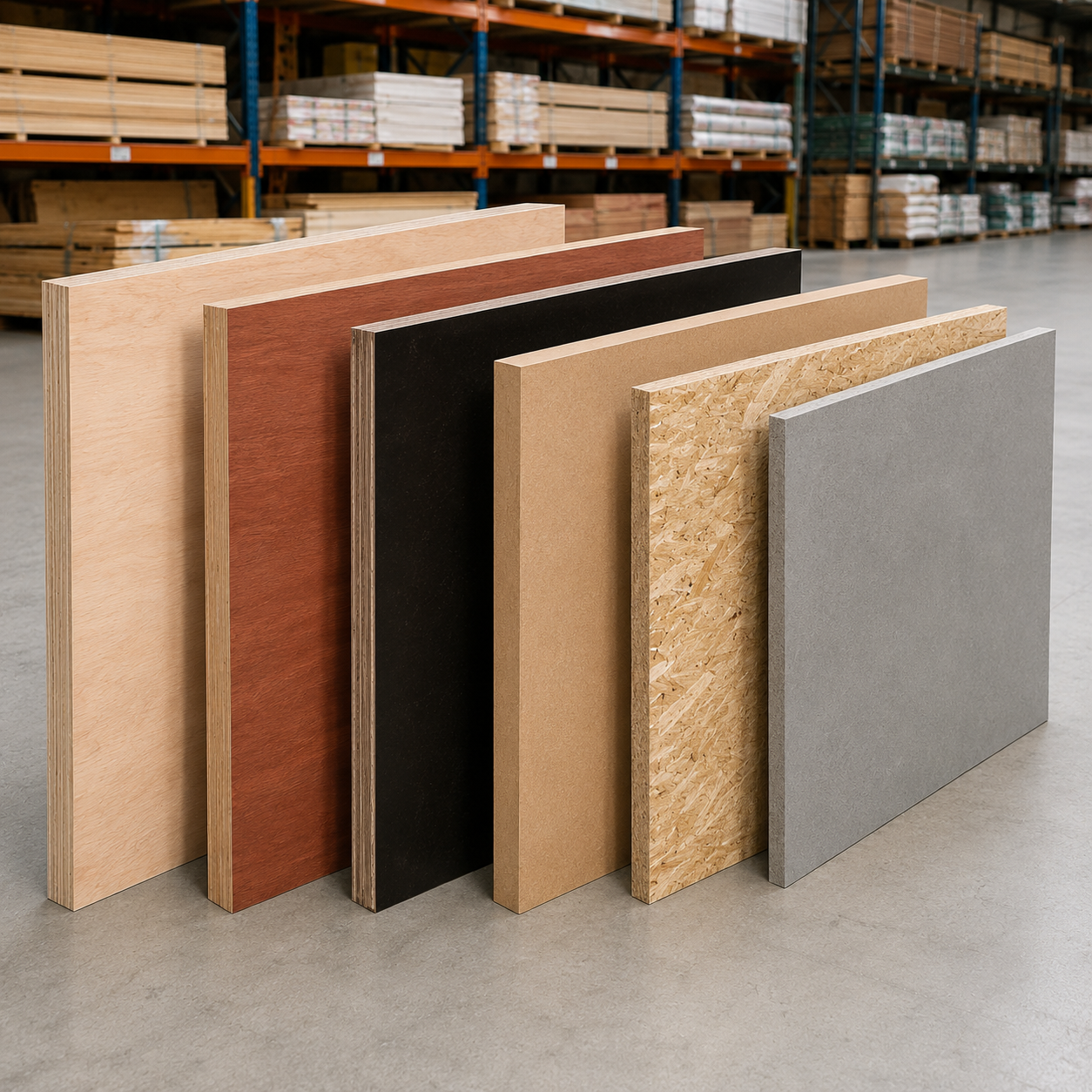
Plywood & Boards
Plywood and construction boards for carpentry, furniture, concrete formwork, partitions, wet areas and general building work. Available products include Commercial Plywood, Marine Plywood, Film-Faced or Tego Plywood, MDF Board, OSB Board and Cement Board in selected sizes, thicknesses and grades.
Description
Plywood and sheet boards provide efficient, consistent surfaces for a wide range of construction and interior applications. Although these products may look similar when stacked, their internal structure, adhesive system, surface finish and resistance to moisture can be very different. Selecting the correct board helps improve durability, finishing quality, installation efficiency and overall project cost.
Cendrex’s Plywood & Boards category brings together six commonly requested products. Commercial Plywood is a versatile choice for dry interior carpentry and general work. Marine Plywood uses more durable veneers and moisture-resistant bonding for demanding environments. Film-Faced or Tego Plywood has a sealed phenolic surface developed for reusable concrete formwork. MDF provides a smooth, uniform surface for furniture and painted interior finishes, while OSB offers an engineered wood-strand panel for sheathing, packaging and temporary structures. Cement Board is a mineral-based alternative for wet areas, ceilings, partitions and tile backing.
Most wood-based panels are commonly supplied in 4 ft × 8 ft sheets, approximately 1,220 × 2,440 mm, although other dimensions may be available. Thickness, face grade, core construction, adhesive classification and manufacturer vary. Customers should confirm the actual specification required by their drawings, consultant or finishing system before ordering.
Product Comparison
| Product | Typical thicknesses* | Surface and core | Moisture suitability | Best suited for |
|---|---|---|---|---|
| Commercial Plywood | 3, 6, 9, 12, 15, 18 and 25 mm | Natural wood veneer faces with cross-laminated veneer core | Mainly dry interiors; moisture performance depends on glue grade | Furniture, cabinets, partitions, shelves and general carpentry |
| Marine Plywood | 6, 9, 12, 15, 18 and 25 mm | Durable face and core veneers with moisture-resistant bonding | Humid and occasionally wet conditions when correctly sealed | Wet-area cabinetry, exterior joinery and boat-related work |
| Film-Faced/Tego Plywood | 12, 15 and 18 mm | Phenolic film faces, laminated plywood core and sealed edges | Designed for wet concrete exposure during formwork cycles | Concrete formwork, shuttering and precast moulds |
| MDF Board | 3, 6, 9, 12, 15, 18 and 25 mm | Smooth wood-fibre faces and uniform dense core | Standard grade for dry interiors; MR grades available | Painted furniture, routed panels, cabinets and displays |
| OSB Board | 6, 9, 12, 15 and 18 mm | Compressed oriented wood strands | Depends on panel class; selected grades tolerate humid conditions | Sheathing, hoarding, packaging and floor substrates |
| Cement Board | 4.5, 6, 9, 12 and 15 mm | Smooth cementitious face with fibre-reinforced mineral core | Suitable for moisture-prone assemblies when correctly installed | Wet-area partitions, ceilings, tile backing and utility spaces |
*Thicknesses are typical market ranges only. Actual stock and manufacturer tolerances may differ.
1. Commercial Plywood
Product Overview
Commercial Plywood is a multi-layer wood panel manufactured by bonding thin veneers with the grain direction of adjoining layers arranged across each other. This cross-laminated construction improves dimensional stability and helps the sheet resist splitting along a single grain direction. Commercial plywood is easy to cut, drill, nail, screw, laminate and paint, making it one of the most versatile boards for carpentry and interior construction.
The quality of commercial plywood depends on more than its thickness. Face veneer grade affects appearance and finishing, while the number of plies, core gaps, timber species and adhesive system influence strength and durability. Lower-cost panels may be suitable for temporary or concealed work, while better face and core grades are preferred for furniture, cabinets and visible finishes.
Typical Specifications
- Common sheet size: 1,220 × 2,440 mm or 4 ft × 8 ft
- Typical thicknesses: 3, 6, 9, 12, 15, 18 and 25 mm
- Face finish: Natural wood veneer; smoothness and patching vary by grade
- Core: Cross-laminated wood veneers
- Bonding: Interior or moisture-resistant adhesive, depending on manufacturer
- Common grade descriptions: Furniture grade, commercial grade, packing grade and other supplier-specific classifications
Recommended Applications
Furniture, cabinets, shelves, wall panels, internal partitions, counters, packaging, temporary protection and general carpentry.
Important Buying Note
Face-grade labels are not identical across every supplier. Confirm the actual sample, core quality, thickness tolerance and adhesive classification rather than relying only on a general grade name.
2. Marine Plywood
Product Overview
Marine Plywood is manufactured with durable face and core veneers together with a water-resistant bonding system. Better-quality marine panels are produced with limited core gaps so water is less likely to collect within internal voids. This construction provides improved performance in humid or occasionally wet environments compared with standard interior plywood.
Marine plywood should still be sealed, particularly along cut edges, drilled holes and exposed faces. The term “marine” does not mean that an unfinished sheet can remain permanently submerged without protection. Where certification is required, specify a recognized marine plywood standard such as BS 1088-certified material and request the relevant documentation. A water-resistant or “WBP” glue description alone does not automatically confirm full marine-grade construction.
Typical Specifications
- Common sheet size: 1,220 × 2,440 mm or 4 ft × 8 ft
- Typical thicknesses: 6, 9, 12, 15, 18 and 25 mm
- Face finish: Durable natural hardwood veneer, often reddish or medium brown
- Core: Selected veneers with reduced internal gaps in better grades
- Bonding: Water-resistant phenolic or equivalent exterior-grade adhesive system
- Certification: Supplier-specific; BS 1088 or another stated standard when formally certified
Recommended Applications
Wet-area cabinets, exterior joinery, boat components, kitchen and bathroom furniture, durable formwork and humidity-prone interiors.
Important Buying Note
Confirm the actual certification, timber species, veneer thickness, core construction and edge condition. All exposed edges should be correctly sealed for the intended environment.
3. Film-Faced or Tego Plywood
Product Overview
Film-Faced Plywood, commonly called Tego Plywood in the Malaysian construction market, is a plywood panel covered with resin-impregnated phenolic film. The sealed surface reduces moisture absorption from wet concrete and helps formwork release more cleanly after curing. A smooth panel can produce a neater concrete surface and reduce the amount of finishing required after the form is removed.
The number of possible reuse cycles is not fixed. It depends on plywood core quality, film weight, formwork support spacing, concrete pressure, release-agent selection, cleaning, edge sealing and site handling. Cutting or drilling exposes the plywood core, so newly exposed edges and holes should be resealed promptly. Panels should be stored flat and protected from standing water and direct ground contact.
Typical Specifications
- Common sheet size: 1,220 × 2,440 mm or 4 ft × 8 ft
- Typical thicknesses: 12, 15 and 18 mm
- Face finish: Smooth black or dark-brown phenolic film
- Core: Multi-ply hardwood, mixed hardwood or supplier-specific plywood core
- Typical film weights: Approximately 120 or 220 g/m², depending on grade and manufacturer
- Edges: Factory-sealed; cut edges require resealing
- Surface options: Smooth/smooth, smooth/wire-mesh or other supplier-specific finishes
Recommended Applications
Wall formwork, slab formwork, columns, beams, precast moulds, shuttering and temporary concrete casting platforms.
Important Buying Note
Do not judge formwork plywood only by surface colour. Confirm the core, number of plies, thickness, film weight, edge sealing and intended reuse expectations.
4. MDF Board
Product Overview
Medium-Density Fibreboard is manufactured from refined wood fibres combined with resin and pressed into a dense, uniform panel. Unlike plywood, MDF does not contain visible veneer layers or natural grain direction. Its smooth faces and consistent core are well suited to painting, laminating and precision routing, especially where a clean decorative finish is required.
Standard MDF absorbs moisture readily through exposed edges and is mainly intended for dry interior use. Moisture-resistant MDF is available for suitable humid interior areas, but it should not automatically be treated as an exterior or waterproof board. MDF is relatively heavy and produces fine dust during cutting, so suitable extraction and respiratory protection should be used.
Typical Specifications
- Common sheet size: 1,220 × 2,440 mm or 4 ft × 8 ft
- Typical thicknesses: 3, 6, 9, 12, 15, 18 and 25 mm
- Surface: Smooth, uniform and ready for paint, veneer or laminate
- Core: Dense compressed wood fibre
- Available variants: Standard, moisture-resistant and fire-retardant grades, subject to supplier
- Edge condition: Smooth but porous; sealing is recommended before painting
Recommended Applications
Cabinets, furniture, routed doors, shelving, decorative wall panels, shop displays and painted interior joinery.
Important Buying Note
Confirm density, thickness tolerance, moisture-resistance grade and formaldehyde-emission classification where these are specified by the project.
5. OSB Board
Product Overview
Oriented Strand Board is an engineered panel made from long wood strands arranged in directional layers and bonded under heat and pressure. The strand orientation gives the board useful strength and stiffness, while its textured appearance makes the material visually distinctive. OSB can provide an economical solution for sheathing, packaging, hoarding and selected flooring or structural substrates.
OSB performance varies by panel classification. Under the European EN 300 system, products may be classified from OSB/1 to OSB/4, covering different structural and moisture conditions. OSB/3 is commonly specified for load-bearing use in humid conditions, but the supplied panel must carry the correct certification before that classification is claimed. Edges and cutouts should be protected from prolonged water exposure.
Typical Specifications
- Common sheet size: Approximately 1,220 × 2,440 mm, depending on manufacturer
- Typical thicknesses: 6, 9, 12, 15 and 18 mm
- Surface: Visible oriented wood strands with a natural textured finish
- Core: Multiple directional layers of compressed wood strands
- Panel classes: OSB/1, OSB/2, OSB/3 and OSB/4 where manufactured and certified to EN 300
- Edge options: Square edge or tongue-and-groove, depending on supplier
Recommended Applications
Wall and roof sheathing, flooring substrates, packaging crates, hoarding, shelving, temporary structures and interior feature panels.
Important Buying Note
Confirm the structural class, thickness, edge profile, fixing requirement and permitted moisture exposure. Do not assume all OSB panels are interchangeable.
6. Cement Board
Product Overview
Cement Board is a rigid mineral-based sheet manufactured from cementitious material reinforced with fibres, mesh or other components depending on the product. It is not a plywood product, but it is included in this category because customers frequently compare it with timber boards for partitions, ceilings and wall lining. Cement board offers better stability in moisture-prone areas and provides a firm substrate for tile and protective finishes.
The board itself is only one part of a complete system. Wet-area performance also depends on framing, fasteners, joint treatment, waterproofing membranes and edge detailing. Different cement boards are produced for interior, exterior, floor, wall or façade applications, so the exact product rating must be checked. Cutting can create mineral dust and should be completed with appropriate tools and dust control.
Typical Specifications
- Common sheet size: 1,220 × 2,440 mm or manufacturer-specific panel sizes
- Typical thicknesses: 4.5, 6, 9, 12 and 15 mm
- Surface: Smooth or lightly textured grey cementitious face
- Core: Fibre-reinforced mineral or cement-based construction
- Edge options: Square, recessed or supplier-specific profiles
- System requirements: Compatible screws, framing, joint compound and waterproofing where required
Recommended Applications
Bathroom partitions, tile backing, ceilings, utility rooms, soffits, wet-area walls, selected exterior lining and fire-rated systems where certified.
Important Buying Note
Confirm whether the exact board is rated for interior, exterior, ceiling, wall or floor use. Fire and moisture claims should match the manufacturer’s current test documentation.
Quick Selection Guide
| Customer requirement | Recommended starting point |
|---|---|
| General interior furniture and carpentry | Commercial Plywood |
| Humid areas or more demanding joinery | Marine Plywood |
| Reusable concrete formwork | Film-Faced/Tego Plywood |
| Smooth painted or routed furniture finish | MDF Board |
| Sheathing, hoarding or packaging | OSB Board |
| Wet-area tile backing or mineral-based partition | Cement Board |
Category Call to Action
Need help choosing the correct sheet? Send Cendrex your required board type, sheet size, thickness, quantity and intended application. Our team can check current stock, supplier grade, bulk pricing and delivery arrangements within Selangor.
Suggested buttons: Request a Quote · Check Current Stock · WhatsApp Cendrex
Publishing Disclaimer
All dimensions, thicknesses, classifications and film weights shown above are typical market references only. Actual specifications vary by brand and manufacturing batch. Confirm the current product datasheet, sample and project requirements before placing an order or publishing a fixed technical claim.