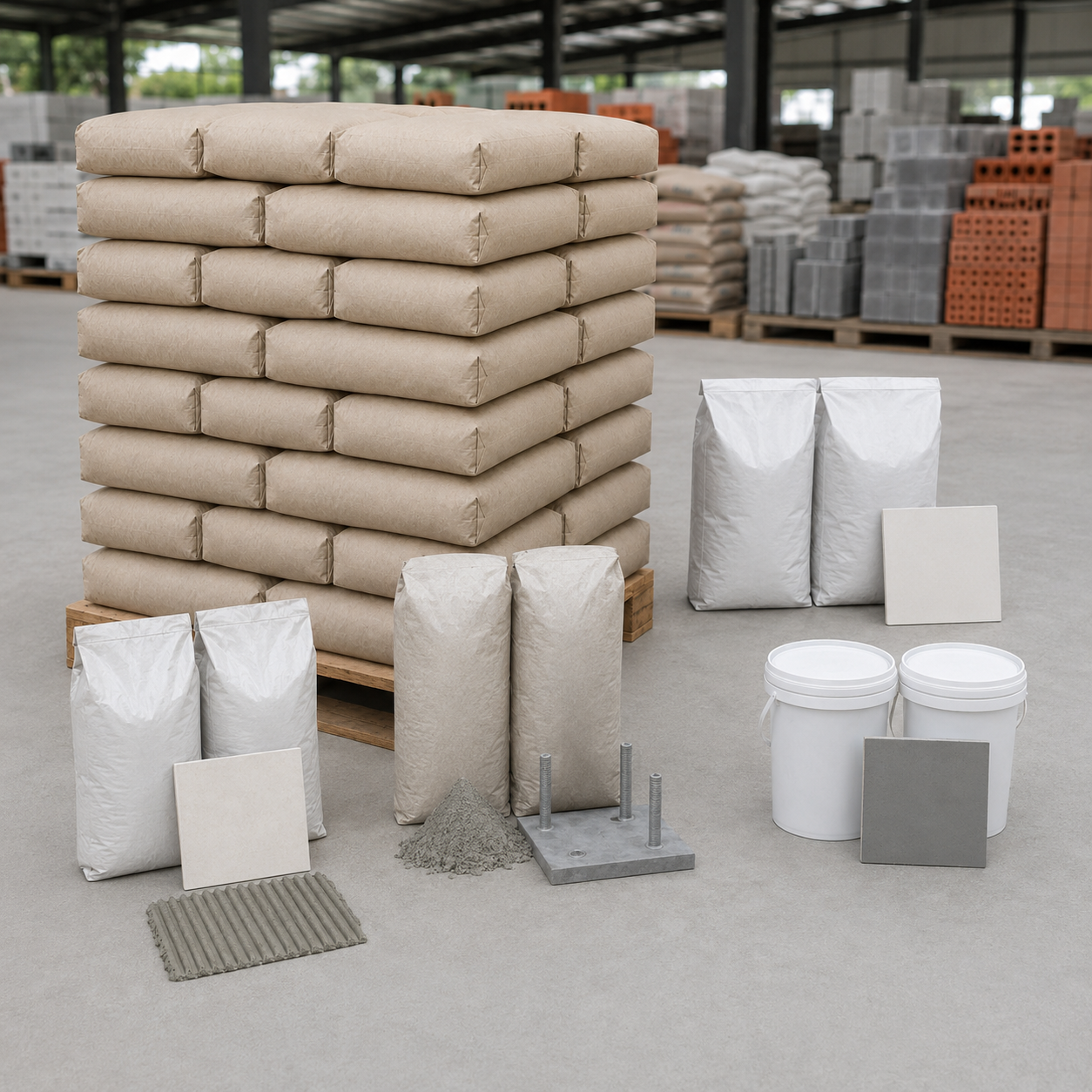
Cement & Cement-Based Products
Bagged cement and cement-based products for concrete, bricklaying, plastering, tiling, grouting, wall finishing and waterproofing work. The range includes Ordinary Portland Cement, General-Purpose Cement, Masonry Cement, Rapid-Hardening Cement, bagged Premixed Concrete, Cement Gum or Tile Adhesive, Non-Shrink Grout, Premixed Wall Plaster, Skim Coat and Cementitious Waterproofing. Contact Cendrex for current brands, bag sizes, product grades, pallet quantities, project pricing and delivery availability in Malaysia.
Description
Cement is the hydraulic binder used in concrete, mortar, plaster and many factory-produced construction materials. Once mixed with the correct quantity of water, it reacts and hardens to bind sand, aggregate or other components together. Although several products in this category contain cement, they are not interchangeable. Structural cement, masonry cement, cement gum, grout, plaster, skim coat and waterproofing compounds are formulated for different layer thicknesses, strengths, workability and exposure conditions.
Cendrex’s core cement range covers Ordinary Portland Cement for conventional structural and general concrete work, General-Purpose Cement for a broad mix of site applications, Masonry Cement for workable bricklaying mortar and plaster, and Rapid-Hardening Cement where approved early-strength development is required. General-Purpose Cement is commonly supplied by the bag and may be packed as 40 bags on a full pallet, depending on the manufacturer and current supplier arrangement.
The related cement-based range helps customers complete more specialised work without blending every ingredient on site. Bagged Premixed Concrete contains controlled proportions of cement, sand and aggregate for small pours and repairs. Cement Gum—also called cementitious tile adhesive in Malaysia—is designed for bonding selected tiles in a controlled thin layer. Non-Shrink Grout fills confined gaps beneath base plates and equipment. Premixed Wall Plaster levels masonry surfaces, while Skim Coat creates a finer finish before painting. Cementitious Waterproofing forms a protective mineral-based coating over prepared concrete, screed or masonry.
For each product, buyers should confirm the intended application, substrate, required strength or classification, bag size, water ratio, coverage, working time, curing method and current technical data sheet. Adding extra water or substituting one cement-based product for another can reduce bond, strength and durability even when the wet mixtures appear similar.
Product Comparison
| Product | Product form | Main function | Typical market reference* | Confirm before ordering |
|---|---|---|---|---|
| Ordinary Portland Cement | Bagged hydraulic cement | Structural and general concrete, mortar and screed | Commonly supplied in 50 kg bags; certification and cement class vary | Cement type, strength class, bag weight, date and project standard |
| General-Purpose Cement | Bagged blended, composite or general construction cement | Everyday concrete, bricklaying, plaster and screed | Commonly 50 kg per bag; selected suppliers pack 40 bags per pallet | Structural suitability, cement classification, bag and pallet quantity |
| Masonry Cement | Bagged cement formulated for mortar workability | Bricklaying, block laying, plaster and render | Bag size and recommended sand ratio vary by manufacturer | Non-structural use, mix ratio, strength and water-retention performance |
| Rapid-Hardening Cement | Bagged cement with higher early-strength development | Approved fast-track concrete, precast work and repairs | Cement class and strength development are manufacturer-specific | Early strength, setting behaviour, heat generation and curing plan |
| Bagged Premixed Concrete | Dry blend containing cement, sand and aggregate | Small concrete pours and repairs | Bag weight, yield and strength class vary | Water quantity, yield, maximum aggregate, strength and curing |
| Cement Gum / Tile Adhesive | Polymer-modified or factory-blended cementitious powder | Bonding tiles to prepared floors and walls | C1, C2, T, E and S1 classifications may be specified | Tile type, size, substrate, location, adhesive class and trowel size |
| Non-Shrink Grout | Flowable cementitious powder | Filling beneath base plates, bearings and machinery | Commonly supplied in bags with product-specific strength data | Pour depth, flow, working time, strength and formwork preparation |
| Premixed Wall Plaster | Cementitious binder, graded sand and additives | Levelling and rendering masonry surfaces | Internal, external, base-coat and other grades may be available | Substrate, coat thickness, coverage, water ratio and curing |
| Skim Coat | Fine cementitious finishing powder | Smoothing plaster or concrete before painting | Base and finish coats; internal or exterior grades vary | Maximum thickness, substrate, colour, drying and paint compatibility |
| Cementitious Waterproofing | Powder-and-liquid or one-component coating system | Protecting concrete and masonry from water penetration | Rigid and flexible grades, pails or multi-component packs | Exposure, movement, coverage, coat count, curing and protection |
*Typical references are for buyer guidance only. Actual Cendrex stock, packaging and performance data must be confirmed from the current brand and batch.
Core Cement Products
1. Ordinary Portland Cement
Ordinary Portland Cement, often abbreviated as OPC, is a traditional hydraulic cement used to make concrete, mortar and screed. When mixed with properly graded sand, aggregate and clean water, it provides dependable strength development for conventional construction. OPC is frequently specified where the designer requires a defined Portland cement composition and performance class.
Concrete quality depends on the complete mix rather than the cement alone. Correct batching, water-cement ratio, aggregate grading, mixing, placement, compaction and curing are all necessary. Increasing water to make a mix easier to place can reduce final strength, increase permeability and contribute to cracking.
Typical buying details:
- Bag weight, commonly 50 kg subject to brand
- Cement type and declared strength class
- Manufacturing or packing date
- Applicable Malaysian or project standard
- Required number of bags or pallets
- Mill or product certification where specified
Recommended applications: Reinforced concrete, foundations, columns, beams, floor slabs, masonry mortar, screed and general concrete work.
Selection note: Follow the engineer’s mix design and cement specification. Do not assume every grey cement bag has the same composition or structural approval.
2. General-Purpose Cement
General-Purpose Cement is developed for a wide range of everyday building applications. Depending on the manufacturer, it may be a blended or composite cement formulated to provide practical workability, consistent strength development and a smooth finish. It is convenient for contractors carrying out concrete, bricklaying, plastering and floor work on the same project.
Cendrex’s representative product imagery uses a full cement pallet. A commonly encountered arrangement is 40 bags per pallet. If each bag is 50 kg, the material alone represents approximately 2,000 kg, excluding the pallet and wrapping. The actual bag weight, pallet quantity and safe truck payload must be confirmed before quotation and delivery.
Typical buying details:
- Cement classification and declared application range
- Bag weight and bags per pallet
- Structural or non-structural suitability
- Manufacturing date and storage condition
- Quantity, unloading method and protected storage area
Recommended applications: General concrete, bricklaying mortar, wall plaster, floor screed, repairs and everyday building work.
Selection note: Confirm the technical classification before specifying General-Purpose Cement for structural concrete. The engineer’s requirements take priority over the general product name.
3. Masonry Cement
Masonry Cement is formulated to produce workable, cohesive mortar and plaster. It can improve spreading, water retention and finishing compared with a basic cement-and-sand mix, helping masons create fuller joints and more consistent render. Its primary role is masonry work rather than high-strength structural concrete.
Sand quality remains important. Poor grading, excessive silt or too much mixing water can reduce strength, increase shrinkage and affect surface finish. Follow the manufacturer’s stated mix ratio and curing instructions for bricklaying or plastering.
Typical buying details:
- Bag weight and product classification
- Recommended cement-to-sand ratio
- Mortar or plaster application
- Workability and water-retention characteristics
- Interior or exterior suitability
Recommended applications: Clay-brick laying, cement-sand brick laying, concrete-block work, wall plaster, render and non-structural masonry.
Selection note: Do not substitute Masonry Cement for structural OPC or another specified cement unless the project documentation expressly permits it.
4. Rapid-Hardening Cement
Rapid-Hardening Cement develops strength faster during the early curing period than conventional cement of comparable final class. This can help shorten approved construction cycles, support earlier formwork removal or return repaired areas to service sooner. Rapid hardening does not necessarily mean instant setting; setting time and early-strength development are different properties.
Faster strength gain can produce more early heat, particularly in thick concrete sections. Mixing, transport, placement and finishing must be planned within the product’s working time, followed by suitable curing. The engineer should approve its use in structural work and evaluate compatibility with the full concrete mix.
Typical buying details:
- Declared early and final strength
- Initial and final setting characteristics
- Compatible mix design and admixtures
- Recommended section thickness
- Curing and temperature-control requirements
Recommended applications: Precast elements, urgent concrete repairs, fast-track slabs, approved road repairs and work requiring planned early strength.
Selection note: Do not select this product based only on the word “rapid.” Confirm the current data sheet, required early strength and complete placement programme.
Related Cement-Based Products
5. Bagged Premixed Concrete
Bagged Premixed Concrete is a dry factory-proportioned blend of cement, graded sand and aggregate. The installer adds the specified amount of clean water, mixes thoroughly and places the material like conventional concrete. It is useful for smaller jobs where ordering a ready-mix truck or measuring separate raw materials would be inefficient.
Bag yield is critical when estimating quantity. The number of bags cannot be calculated accurately from bag weight alone because aggregate grading and compacted yield vary by product. Use the manufacturer’s stated litres or cubic-metre yield and allow for site wastage. The material still requires correct placement, compaction, finishing and curing.
Recommended applications: Fence posts, kerbs, small equipment pads, steps, small slabs, concrete patching and general repairs.
Selection note: Confirm strength class, maximum aggregate size, bag yield, water requirement, working time and curing instructions.
6. Cement Gum / Cementitious Tile Adhesive
Cement Gum is the familiar Malaysian hardware term for cementitious tile adhesive. It is a factory-made powder containing cement, selected fillers and performance additives. After mixing with the specified amount of water—or an approved liquid additive for certain products—it is spread with a notched trowel to form a controlled bonding bed for wall or floor tiles.
Cement gum should not be treated as ordinary cement with a different label. The correct adhesive depends on tile absorption, tile size, substrate, interior or exterior exposure, moisture, temperature and expected movement. A flat, stable and properly prepared substrate is essential. The adhesive must be applied within its open time, with adequate transfer to the back of the tile and movement joints maintained where required.
Under EN 12004-style classifications, C identifies a cementitious adhesive, 1 a normal class and 2 an improved class. Additional letters can identify properties such as reduced slip (T), extended open time (E) and deformability (S1 or S2). These markings should only be claimed when shown on the actual product documentation.
Recommended applications: Ceramic tiles, porcelain or homogeneous tiles, mosaics and selected natural stone on suitable floors and walls.
Selection note: Basic C1 products may suit selected small absorbent ceramic tiles under normal conditions, while porcelain, larger formats, exterior work or demanding substrates may require C2 or a higher-performance formulation. Follow the tile and adhesive manufacturers’ instructions.
7. Non-Shrink Grout
Non-Shrink Grout is a high-flow cementitious material developed to create continuous bearing beneath equipment, structural steel and precast components. It fills confined gaps and is formulated to compensate for normal shrinkage during the specified hardening stage. Correctly installed grout transfers load through a continuous contact area rather than a few isolated points.
The supporting concrete should be sound, clean and prepared as required by the manufacturer. Formwork must be watertight and arranged for continuous placement. Adding excessive water may increase flow temporarily but can cause segregation, bleeding and reduced strength. Deep placements may need a special grade or approved aggregate extension.
Recommended applications: Machine bases, steel base plates, anchor bolts, bridge bearings, precast joints and selected structural repairs.
Selection note: Confirm pour depth, flow consistency, working time, early and final compressive strength, substrate preconditioning and curing.
8. Premixed Wall Plaster
Premixed Wall Plaster combines cementitious binder, graded sand and controlled additives in one bag. It reduces on-site proportioning and helps improve consistency between batches. The product is commonly used to level clay brick, cement-sand brick, concrete block and other compatible masonry before skim coating or decorative finishing.
The wall must be stable, clean and free from dust, oil, loose mortar and contamination. Smooth concrete may require mechanical preparation or an approved bonding treatment. Very deep corrections should be built in suitable coats rather than applied as one overly thick layer. Protection from rapid drying and correct curing help limit shrinkage cracking.
Recommended applications: Internal and external masonry walls, brickwork, blockwork, repair patches and general surface levelling.
Selection note: Confirm internal or external rating, recommended thickness per coat, water ratio, coverage, curing and compatibility with the final skim coat or paint system.
9. Skim Coat
Skim Coat is a fine cementitious finishing material applied in thin layers over prepared plaster or concrete. It fills minor pores, shallow imperfections and trowel marks to produce a smoother base for paint. Some systems use a coarser base coat followed by a finer finish coat, while other products are formulated for a specific substrate or exposure condition.
Skim coat is not designed to level severely uneven walls or bridge moving cracks. Major defects should be repaired first, and the surface must be clean, stable and within the product’s moisture requirements. Applying the material too thickly can cause cracking, debonding or extended drying.
Recommended applications: Internal walls, ceilings, prepared wall plaster, concrete surfaces and selected exterior walls where the product is rated accordingly.
Selection note: Confirm base or finish grade, maximum thickness, interior or exterior rating, drying time, sanding requirement and paint compatibility.
10. Cementitious Waterproofing
Cementitious Waterproofing is a mineral-based coating system designed to bond to prepared concrete, screed and masonry. Products may be supplied as a single-component powder mixed with water or as a powder-and-liquid set. Flexible formulations are designed to accommodate limited movement, while rigid formulations are more appropriate for stable mineral substrates.
Waterproofing performance depends on the complete system. Cracks, corners, joints, penetrations and floor traps require suitable detailing before the main coats are applied. The specified coverage and number of coats must be achieved, and each layer needs the required drying or curing time. The finished membrane should be protected from damage before tiling, screeding, backfilling or service.
Recommended applications: Bathrooms, balconies, kitchens, water tanks, retaining walls, lift pits and concrete or masonry surfaces covered by the product approval.
Selection note: Confirm positive or negative water pressure, substrate movement, internal or external exposure, potable-water suitability where relevant, coverage and protective finish.
Quick Selection Guide
| Customer requirement | Recommended starting point |
|---|---|
| Engineer-specified structural concrete | Ordinary Portland Cement or the exact specified cement class |
| General everyday concrete, mortar and plaster | General-Purpose Cement after confirming application suitability |
| Workable bricklaying mortar or render | Masonry Cement |
| Approved early-strength construction or repair | Rapid-Hardening Cement |
| Small concrete job requiring convenient controlled proportions | Bagged Premixed Concrete |
| Bonding tiles with a notched-trowel thin bed | Cement Gum / Cementitious Tile Adhesive |
| Filling beneath a machine or steel base plate | Non-Shrink Grout |
| Levelling a brick or block wall | Premixed Wall Plaster |
| Creating a smooth surface before painting | Skim Coat |
| Coating prepared concrete or masonry against water | Cementitious Waterproofing |
Information to Send with a Quotation Request
- Product name and intended application
- Required brand or technical classification, if specified
- Bag, pail or set quantity
- Project drawings or consultant specification where applicable
- Tile type and size for cement gum enquiries
- Required thickness, area and substrate for plaster, skim coat or waterproofing
- Delivery address and preferred date
- Site access and unloading arrangement
- Required certificate or technical data sheet