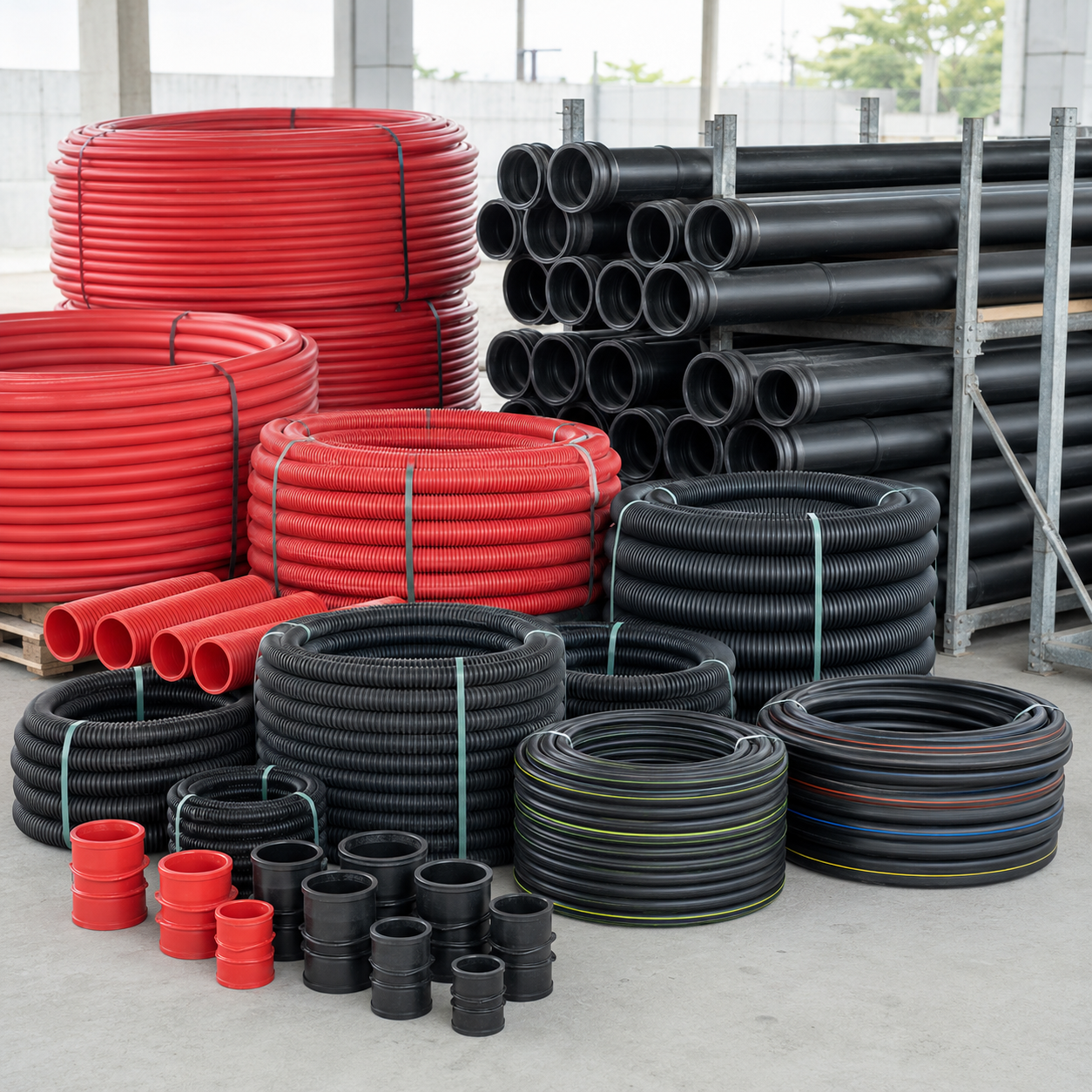
TELEKOM/ TNB Pipe / Conduit
A comprehensive range of cable pipes and ducts for underground power, telecommunications and fibre-optic infrastructure. Products include TNB-type solid-wall and double-wall corrugated pipes, uPVC Telekom ducts, HDPE sub-ducts, fibre-optic microducts and compatible connection accessories.
Description
Cable pipes and ducts provide secure protection and organised routing for underground electrical, telecommunications and fibre-optic cables. They are commonly installed in utility networks, substations, road crossings, commercial developments, industrial facilities, data networks and broadband infrastructure.
The range includes red HDPE solid-wall power cable pipes, TNB-type double-wall corrugated ducts, uPVC Class B cable sleeves, black uPVC Telekom pipes, HDPE corrugated sub-ducts, smooth-wall fibre-optic ducts and microduct systems. Pipes may be supplied in straight lengths, coils or drums, depending on their material, diameter and project requirements.
HDPE cable pipes offer flexibility, impact resistance, corrosion resistance and suitability for open-trench or trenchless installations. Double-wall corrugated pipes combine a strong corrugated exterior with a smoother internal surface for cable pulling. uPVC ducts provide a rigid and lightweight cable protection system, while smaller sub-ducts and microducts help separate, identify and install telecommunications or fibre-optic cables.
Compatible accessories may include connection sleeves, couplers, reducers, end caps, sealing plugs, draw ropes and other installation fittings.
Common Cable Pipe Types
| Product type | Typical application |
|---|---|
| TNB-Type HDPE Solid-Wall Cable Pipe | Underground power cables, substations, road crossings and HDD installations |
| TNB-Type HDPE Double-Wall Corrugated Pipe | Underground electrical cable protection and concrete-encased crossings |
| uPVC Class B Cable Pipe | Protective cable sleeve for selected power-cable installations |
| uPVC Telekom Cable Pipe | Main telecommunications duct for underground cable networks |
| HDPE Corrugated Sub-Duct | Internal sub-duct for telecommunications and fibre-optic cables |
| HDPE Smooth-Wall Sub-Duct | Cable pulling and fibre-optic installation inside larger ducts |
| Fibre-Optic Microduct | Direct-buried or internally installed duct for blown fibre |
| HDPE Telekom/HDD Duct | Telecommunications cable routes installed using trenchless methods |
Common Size Ranges
| Product type | Common sizes | Common supply length |
|---|---|---|
| HDPE Solid-Wall Power Cable Pipe | 110, 160, 180 and 200 mm | 6 m, 12 m or coils, depending on size |
| HDPE Double-Wall Corrugated Cable Pipe | 100, 150 and 200 mm | 6 m or approximately 30–50 m coils |
| uPVC Class B Cable Pipe | Commonly 100–200 mm | Approximately 5.8–6 m |
| uPVC Telekom Cable Pipe | Commonly 107 mm | Approximately 6 m |
| HDPE Corrugated Sub-Duct | Commonly 32, 40 and 50 mm OD | Supplied in long coils |
| HDPE Smooth-Wall Sub-Duct | Commonly 32–50 mm OD | Coil or drum |
| Fibre-Optic Microduct | Commonly 10/6 and 12/8 mm OD/ID; other sizes available | Coil or drum |
| HDPE Telekom/HDD Duct | Commonly 110 mm OD | Straight length or coil |
Actual sizes, internal diameters, wall thicknesses and coil lengths depend on the selected manufacturer and product specification.
Common Specification and Rating Systems
| System or rating | Application |
|---|---|
| PN Rating | Commonly used for solid-wall HDPE pipes; PN10 is frequently specified for TNB-type red cable pipes |
| SDR Rating | Ratio between pipe outside diameter and wall thickness for solid-wall HDPE pipes |
| PE Material Grade | Commonly PE80 or PE100, depending on manufacturer and project specification |
| Ring Stiffness or Profile Class | Used for double-wall corrugated pipes to indicate resistance to external loading |
| SN Rating | SN4 or SN8 may be specified for selected corrugated duct systems |
| PVC Class | Class B may be specified when uPVC pressure-pipe dimensions are used as cable sleeves |
| OD/ID System | Sub-ducts and microducts are normally specified using outside and internal diameters |
| Wall Thickness | Important for uPVC Telekom pipes, HDPE sub-ducts and microducts |
| Bend Radius | Important for coiled pipes, HDD ducts, sub-ducts and fibre-optic microducts |
PN ratings refer to the pipe’s nominal pressure classification. Cable ducts normally operate without internal pressure, but PN or SDR may still be used to specify the pipe’s wall thickness and physical construction.
Corrugated cable pipes are generally selected according to external-load performance, profile class or ring stiffness rather than internal working pressure.
Common Standards and Requirements
- TNB technical specifications, approved product requirements and project drawings
- Telekom Malaysia Specification D 0016 for selected HDPE corrugated sub-ducts
- MS 1034 for uPVC underground telecommunications ducts
- DIN 16961 for selected HDPE double-wall corrugated pipes
- MS 1058 or ISO 4427 dimensional requirements for selected solid-wall HDPE pipes
- MS 628 for selected uPVC Class B pipes used as protective cable sleeves
- SIRIM product certification where required
- Manufacturer test reports and project-specific approvals
Standards, certifications and utility approvals must be verified against the exact brand, model and manufacturing batch offered.
Common Materials
- PE80 high-density polyethylene
- PE100 high-density polyethylene
- Profiled HDPE for double-wall corrugated ducts
- Unplasticised polyvinyl chloride, also known as uPVC or PVC-U
- HDPE or uPVC connection sleeves and couplers
- Rubber sealing rings for selected jointing systems
- Nylon or polyester pull strings and draw ropes
- Coloured identification stripes for selected fibre-optic sub-ducts
Important Ordering Information
Please confirm the following before placing an order:
- Intended application: TNB power, telecommunications or fibre optic
- Solid-wall, double-wall corrugated, uPVC, sub-duct or microduct type
- Nominal size, outside diameter and internal diameter
- Required straight length, coil length or drum length
- Material grade, such as PE80, PE100 or uPVC
- PN, SDR, wall thickness, ring stiffness or profile class
- Pipe colour and required identification stripes
- Open-trench, concrete-encased, direct-buried or HDD installation
- Cable quantity, cable diameter and required duct capacity
- Minimum bending radius for coiled pipes and fibre ducts
- Connection method and required couplers
- Requirement for draw rope or pre-installed pull string
- Required TNB, Telekom Malaysia, SIRIM or project approval
- Required certificates, test reports and manufacturer documentation
- Delivery access and handling requirements for long pipes, large coils or drums
Technical Notice
Cable-pipe sizes and ratings are not interchangeable across different systems. A 107 mm uPVC Telekom duct, 110 mm HDPE power cable pipe and 100 mm double-wall corrugated pipe may have different internal diameters, wall thicknesses, connections and approval requirements. Always confirm the complete project specification before ordering.