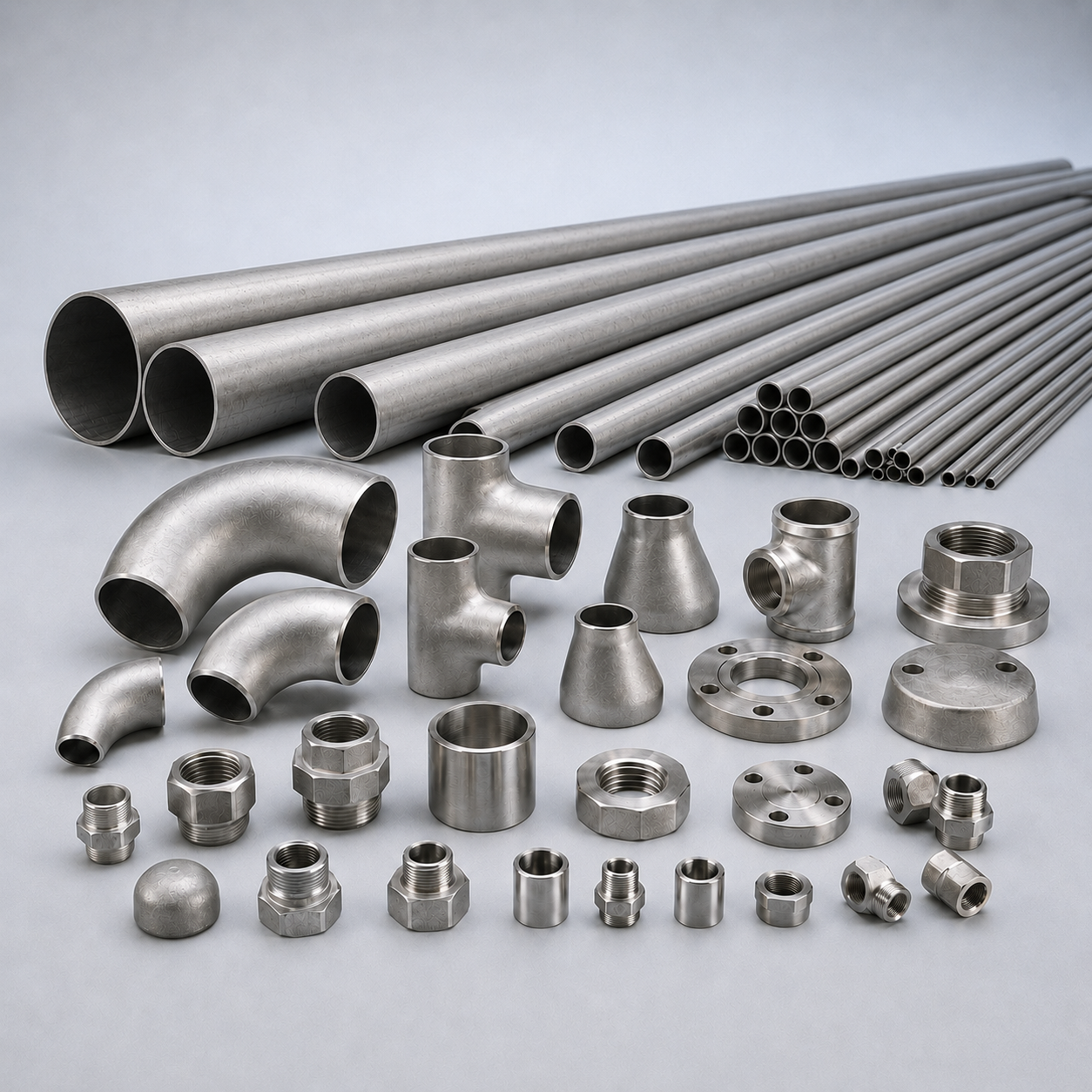
Stainless Steel Pipes & Fittings
Stainless-steel pipes and fittings provide a strong, hygienic and corrosion-resistant piping solution for water supply, commercial plumbing, food and beverage processing, industrial services and general fluid-transfer systems.
The range includes welded and seamless pipes, butt-weld fittings, threaded fittings, socket-weld fittings and flanged connections in SS304, SS304L, SS316 and SS316L material grades.
Products are available in different nominal pipe sizes, wall schedules, pressure classes, connection types and surface finishes to meet various installation and project requirements.
Description
Common Product Types
| Product category | Common products |
|---|---|
| Stainless-Steel Pipes | Welded and seamless pipes in various wall schedules |
| Butt-Weld Fittings | Elbows, tees, reducers, caps and stub ends |
| Threaded Fittings | Elbows, tees, sockets, unions, bushes, nipples and adaptors |
| Socket-Weld Fittings | Elbows, tees, couplings, unions and branch connections |
| Stainless-Steel Flanges | Slip-on, weld-neck, blind, threaded and lap-joint flanges |
| Pipe Accessories | Plugs, caps, backing rings, gaskets and connection components |
Stainless-Steel Material Grades
SS304 and SS304L
SS304 is a widely used general-purpose stainless-steel grade offering good corrosion resistance, strength, cleanliness and ease of fabrication.
Common applications include:
- Commercial water piping
- Food and beverage processing
- Kitchen and sanitary installations
- General industrial piping
- Compressed-air systems
- Pump and equipment connections
- Indoor and mildly corrosive environments
SS304L has a lower carbon content, providing improved resistance to intergranular corrosion after welding. It is commonly preferred for fabricated and welded piping systems.
SS316 and SS316L
SS316 contains molybdenum, providing improved corrosion resistance compared with SS304 in many demanding environments.
Common applications include:
- Coastal and marine-influenced environments
- Chemical-processing systems
- Food and beverage production
- Pharmaceutical and hygienic installations
- Water-treatment facilities
- Wastewater systems
- Industrial process piping
- Outdoor installations exposed to higher corrosion risks
SS316L combines the enhanced corrosion resistance of SS316 with a lower carbon content, making it suitable for welded piping and fabricated components.
Material selection must consider the conveyed medium, chloride concentration, temperature, cleaning chemicals and surrounding environment. SS316 is more corrosion resistant than SS304, but it is not completely immune to corrosion or automatically suitable for continuous seawater service.
Stainless-Steel Pipe Types
Welded Stainless-Steel Pipe
Welded pipe is manufactured from stainless-steel strip or plate formed into a cylindrical shape and welded along the seam.
It is commonly used for:
- Water supply
- Commercial plumbing
- Food-processing lines
- General industrial services
- Low- and medium-pressure piping
- Fabricated piping systems
Seamless Stainless-Steel Pipe
Seamless pipe is manufactured without a longitudinal welded seam. It is commonly selected for demanding pressure, temperature or process applications where required by the project specification.
The choice between welded and seamless pipe should be based on the applicable design standard, pressure, temperature, corrosion allowance, inspection requirements and project specification.
Common Pipe Schedules
Pipe schedule describes the nominal wall-thickness series. It does not identify the stainless-steel material grade.
Common stainless-steel pipe schedules include:
| Pipe schedule | General description |
|---|---|
| Schedule 5S | Lightweight stainless piping for selected low-pressure applications |
| Schedule 10S | Light-wall piping commonly used for water and general process services |
| Schedule 40S | Medium-wall piping for commercial and industrial applications |
| Schedule 80S | Heavy-wall piping for more demanding pressure and mechanical requirements |
For the same nominal pipe size, a higher schedule generally indicates a thicker wall and a smaller internal flow diameter.
The allowable working pressure cannot be determined from the schedule alone. Pipe size, material grade, temperature, manufacturing standard, jointing method and system design must also be considered.
Butt-Weld Fittings
Butt-weld fittings are welded directly to compatible stainless-steel pipes to create a continuous piping system.
Common products include:
- 45° elbows
- 90° long-radius elbows
- 90° short-radius elbows
- Equal tees
- Reducing tees
- Concentric reducers
- Eccentric reducers
- End caps
- Stub ends
- Fabricated bends and branches
Butt-weld fittings should match the connecting pipe’s nominal size, wall schedule, material grade and dimensional standard.
Threaded Fittings
Threaded stainless-steel fittings provide removable mechanical connections for smaller-diameter piping systems.
Common products include:
- Straight sockets and couplings
- 45° and 90° elbows
- Equal and reducing tees
- Crosses
- Barrel nipples
- Hexagonal nipples
- Male and female adaptors
- Unions
- Reducing bushes
- Plugs and end caps
- Hose and equipment adaptors
Threaded fittings may use BSP, BSPT or NPT threads. Similar-looking thread systems should not be mixed without confirming their compatibility.
Socket-Weld Fittings
Socket-weld fittings receive the pipe into a recessed socket before welding. They are generally used for smaller-diameter, higher-integrity piping systems.
Common products include:
- Socket-weld elbows
- Socket-weld tees
- Full and reducing couplings
- Socket-weld unions
- Branch fittings
- Socket-weld adaptors
Socket-weld fittings are commonly classified by pressure class rather than pipe schedule.
Stainless-Steel Flanges
Flanges provide removable connections between pipes, valves, pumps, tanks and other equipment.
Common flange types include:
- Slip-on flanges
- Weld-neck flanges
- Blind flanges
- Threaded flanges
- Lap-joint flanges
- Plate flanges
- Stub ends and backing flanges
Flanges must be selected according to the required nominal size, pressure class, material grade, facing type and drilling standard.
Common flange standards may include:
- ASME/ANSI
- JIS
- DIN
- EN
- BS
- Project-specific drilling arrangements
Flanges from different standards are not automatically interchangeable, even when their nominal sizes appear similar.
Common Sizes
Stainless-steel pipes and fittings are commonly specified using nominal pipe size:
- ⅛”
- ¼”
- ⅜”
- ½”
- ¾”
- 1″
- 1¼”
- 1½”
- 2″
- 2½”
- 3″
- 4″
- 5″
- 6″
- 8″
- 10″
- 12″ and above
Actual availability depends on the pipe type, material grade, schedule, fitting design and project quantity.
Common Surface Finishes
Available finishes may include:
- Mill finish
- Annealed and pickled finish
- Brushed finish
- Polished finish
- Internal hygienic polish
- External decorative polish
- Project-specified surface roughness
Food, beverage, pharmaceutical and hygienic applications may require controlled internal surface finishes, suitable joint designs and specific cleaning standards.
Common Standards
- ASTM A312/A312M – Seamless and welded austenitic stainless-steel pipes
- ASTM A403/A403M – Wrought austenitic stainless-steel pressure fittings
- ASTM A182/A182M – Forged stainless-steel flanges and forged fittings
- ASME B36.19M – Stainless-steel pipe dimensions
- ASME B16.9 – Factory-made wrought butt-welding fittings
- ASME B16.11 – Forged socket-weld and threaded fittings
- ASME B16.5 – Pipe flanges and flanged fittings
- Applicable BSP, BSPT or NPT thread standards
- Project-specific water, food-grade, industrial or authority requirements
Compliance must be verified against the exact manufacturer, product grade, size, schedule and fitting offered.
Common Applications
- Commercial and industrial water supply
- Food and beverage processing
- Kitchen and sanitary installations
- Water-treatment systems
- Pump rooms and equipment connections
- Chemical and process piping
- Compressed-air systems
- Pharmaceutical production
- Wastewater treatment
- Cooling-water circulation
- Fire-protection piping, subject to approval
- Coastal and marine-influenced installations
- General industrial fluid transfer
Important Ordering Information
Please confirm the following before ordering:
- Pipe or fitting type
- SS304, SS304L, SS316 or SS316L grade
- Welded or seamless pipe
- Nominal pipe size
- Required wall schedule
- Pipe length and quantity
- Butt-weld, socket-weld, threaded or flanged connection
- Fitting type, angle and configuration
- Equal or reducing size
- BSP, BSPT or NPT thread
- Flange type and pressure class
- Flange drilling standard
- Required surface finish
- Operating pressure and temperature
- Conveyed medium and chemical composition
- Indoor, outdoor, coastal or industrial environment
- Required material test certificate
- Required inspection, testing and project documentation
Technical Notice
SS304 and SS316 are material grades, while Schedule 10S, 40S and 80S indicate pipe wall-thickness series. Terms such as “SCH304” or “SCH316” should not be used as complete product specifications.
Stainless-steel pipe and stainless-steel tube may also use different dimensional systems. Pipe is normally specified by nominal pipe size and schedule, while tube is often specified by its actual outside diameter and wall thickness.
Always verify the material grade, nominal size, wall schedule, manufacturing method, connection standard, pressure requirements and chemical compatibility before ordering.